A. V Mather
A. V. Mather is a Brisbane-based speculative fiction writer. You can follow her on Twitter @AVMather
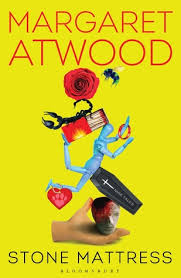 ‘In these nine tales, Margaret Atwood ventures into the shadowland…’ states the dust jacket for Stone Mattress, her latest collection of short stories. Let me start by saying that they are not kidding around…
In this collection, Atwood presents a cautionary assortment of lives lived and loves lost. They are tales of the doomed, both virtuous and unredeemable, of nasty scheming and back stabbing, of people whose lives have been shattered through carelessness or animosity. They are catalogues of hurts, small and large, and examples of the character that might be built from such events.
Three of the nine tales are interlinked, offering different perspectives on a shared chapter in the lives of the same group of people. The events of their time together have affected the course of each life and preoccupy their thoughts in the present day.
The six remaining works range in subject matter from the macabre to the melancholic. The fourth presents the case of a young woman who is a medical anomaly, living in a small village amongst people who view her as a monster. In the fifth, a recently divorced and opportunistic man seeks adventure. The sixth tells of a trio of friends who believe that a violent and charismatic woman from their past has reincarnated as one of the group’s pet dog. The seventh is a Poe-like tale of an impulsive contract between student housemates which restricts the success of one. And in the final tale, a group of senior citizens living in an aged care home become the focus of a terrorist group. As can be clearly seen here, dark subject matter and dark humour abound.
As a group, these stories deal with themes of ageing, frailty, social stigmas, isolation – chosen and imposed – and small worlds. A common thread lies in the motif of imminent or sudden death. All of the characters are facing death in some form: their own mortality, the death of a friend or loved one, the end of love, putting to death old grievances, or even murder.
Another theme underpinning the action lies in the character’s motivation. They have all reached some sort of crisis point –either inevitable or beyond their control. For some, this is due to an imposed condition like disease, impairment, or the effects of time, which then affects their actions. For others, their own characters have led them to a moment of action which defines the framework of their lives. Some view their situation with self-pity, while others are stoic in the extreme, but all are very self-focussed and inward-looking.
Each tale has that atmosphere of danger, the slightly skewed vision and fatalistic creepiness that makes for a true dark tale. Surprisingly, there are also moments of bright optimism and the sort of ‘blinkers-off’ humour that develops when life is stripped of all its romantic trappings. A sense of seeing things as they really are, through the illusions that people conjure. Examples of this may be found in the characters’ observations of life and their own situation, or of the foibles and actions of others.
So, why has Atwood chosen to call them ‘tales’ rather than ‘stories’? In her Acknowledgements, she refers to this collection as evoking ‘the world of the folk tale’ as opposed to a story, which implies that the events take place ‘within the boundaries of social realism.’ To me, her delineation between the two terms best describes the overall allegorical flavour of these dark sagas, peopled by narcissists, braggarts, and plotters of nefarious deeds.
I’m ashamed to admit that this is the first of Margaret Atwood’s books that I have read, and I feel horribly unqualified to review it. So look no further than the praise on the back cover from Germaine Greer, Michael Ondaatje, and John Updike for an idea of her milieu.
But if, like me, you are coming to this book from purely a punter’s perspective, what I can say with certainty is this: Margaret Atwood writes exceptionally well. Her prose is economical and yet it reads like the most intricate lace. How she manages to weave in so many details and still make it seem uncluttered was both a mystery and a joy to me. The wonderful and varied atmosphere of tension throughout showcases her deft control of the pacing.
I would place Stone Mattress as being accessible to any reader with the exception of younger teens, for whom the subject matter may be beyond their experience of life.
As parables of age and loss, these tales work extremely well. They force you to consider the ‘stuffing’ of life – the petty, often pointless views and opinions that fill up lives and amount to nothing in the end. Stone Mattress confronts the reader with the sad truth that by the time most people realise this it is usually too late. Most wisdom is learned in hindsight, which can be either blessing or curse.


 Possibly the biggest highlight of the year was being awarded a scholarship to do my Masters in Philosophy (by creative practice) at the University of Queensland which begins February 2015. I’m delighted to have Dr Jo Robertson as my thesis supervisor and Venny Armano as my creative supervisor. The thesis is on the topic of future feminism as envisioned by female SF writers. I can hardly wait to start the reading for it! To support that, I’ll be writing a feminist SF novella (Pharmakon). Kim Wilkins and Ros Petelin were a great help in getting me organised on this application, and I’m indebted to them both. Also to Louise Thurtell who wrote the most stunning reference for me. Love you Louise!